

Most credit mistakes happen before the first purchase, because AI video generator pricing is not one system. It is at least five, and buyers walk in assuming the one they know. Our database records the pricing model for all 114 AI media tools we track, and the split explains why credits, specifically, are where the money leaks.
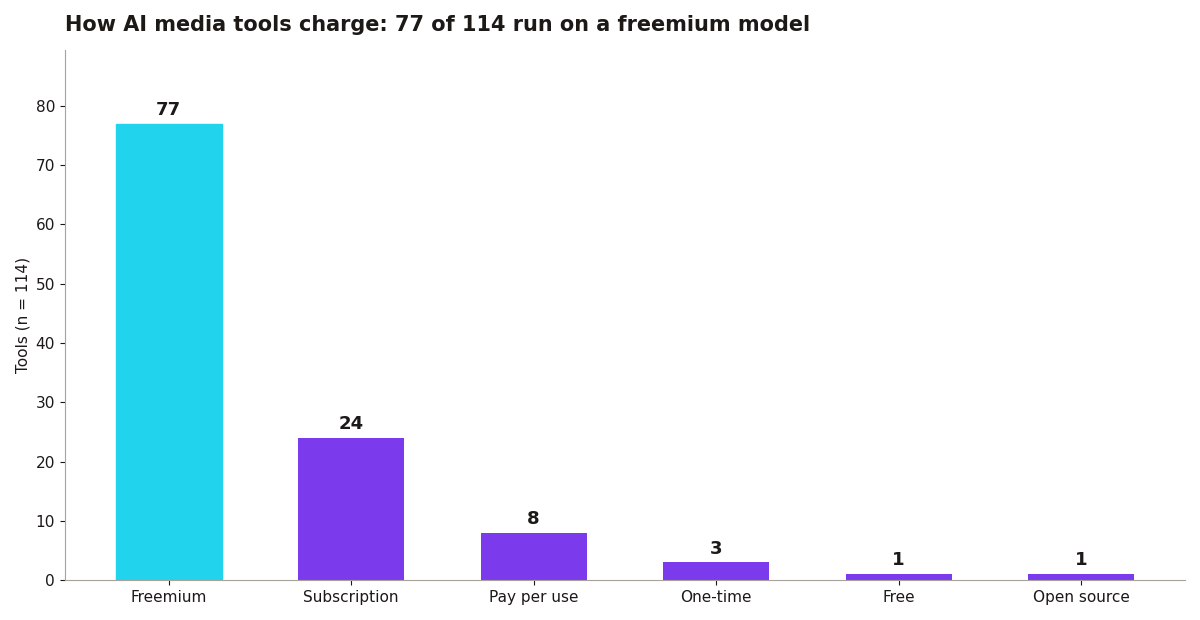
The pricing landscape, counted. Seventy seven of the 114 tools run on a freemium model, where credits and tiers mix together. Twenty four are straight subscriptions. Eight charge pay per use, three are one-time purchases, one is free, and one is open source. Meanwhile, 105 of the 114 tools publish a monthly price figure, ranging from $2.00 to $65.95, and the 24 pure subscription tools carry a median starting price of $29 a month. The practical point: 85 of 114 tools sell through freemium or pay-per-use models, and those are exactly the models where a credit balance, an expiry date, and a per-second rate decide what you really paid. Subscription buyers argue about tiers. Credit buyers have to do arithmetic.
Mistake 1: confusing credits with minutes. A credit is almost never a minute. Kling charges per second, Runway per generation with length multipliers, HeyGen per video minute. Convert everything to dollars per finished second before you compare anything, or the comparison is fiction.
Mistake 2: ignoring expiry. Many credit packs expire in 30 to 60 days. Buying 10,000 credits on sale and using 500 is not a deal. It is a donation with a dashboard.
Mistake 3: paying for drafts. Every regeneration burns credits. Write the script properly first; iterating on a bad prompt at $0.50 a generation adds up fast. The cheapest generation is the one you do not need because the script was right.
Mistake 4: buying before testing free tiers. With 92 of the 114 tools in the database offering a free tier, there is rarely a reason to guess. If you have not generated 20 test clips free, you do not know your volume, and volume is the only honest basis for choosing a pack size.
Mistake 5: forgetting the commercial license. Some cheap tiers exclude commercial use. A bargain plan that cannot legally touch client work is not a plan. Check the license on the exact tier you are buying, not the tier in the advertisement.
Why pay per use deserves respect, and caution. Only 8 of the 114 tools charge pure pay per use, billing by the second of video, the image, or the megapixel. At low volume this is the fairest model in the database: you pay for exactly what you render, and a quiet month costs almost nothing. At high volume the same model becomes the most dangerous, because nothing interrupts the spending. There is no tier ceiling and no renewal email, just a meter. If your workflow regenerates often, and every creative workflow does, model your cost at three times your expected finished volume before choosing a metered tool. The drafts are part of the bill whether you planned for them or not.
One-time pricing is rare, and that is the point. Only 3 of the 114 tools sell for a one-time price, and one more is free while another is open source. The near disappearance of one-time pricing is why credit discipline matters so much now. A generation ago you bought software and the marginal cost of experimenting was zero. In the credit economy, every experiment has a price tag, which quietly changes how people create: they prompt less boldly, test fewer styles, and settle earlier. Budgeting a deliberate test allowance, a fixed monthly sum you are allowed to waste on exploration, restores the old freedom inside the new model. Teams that skip the allowance do not save the money. They just spend it later, on safer and duller work.
The antidote. Track one month of real usage on free tiers, convert it to a per-second cost, then buy the smallest tier that covers it. Before any purchase, run the tool through the Before You Pay checker to see the cost at your volume rather than the headline price. And for talking-head videos specifically, skip the credit casino: AvatarTalk charges a flat $9.99 one-time per video, script in, spokesperson video out. Flat pricing will not suit every workflow, but it proves the point of this whole list. When the pricing model is simple, the mistakes mostly disappear.